
Motor Tax in Ireland Explained

What is Motor Tax?
Motor tax is the annual charge you must pay to legally drive a vehicle on public roads in Ireland. It applies to almost every vehicle on Irish roads — cars, vans, motorcycles and more — and it is a legal requirement, not an optional extra.
The amount you pay depends mainly on when your car was first registered. Ireland currently operates three different motor tax systems, and understanding which one applies to your car is the starting point for everything else.
This guide covers all three systems, the current 2026 rates, how to pay, and a range of practical tips that could save you money — including things that official government websites rarely explain clearly.
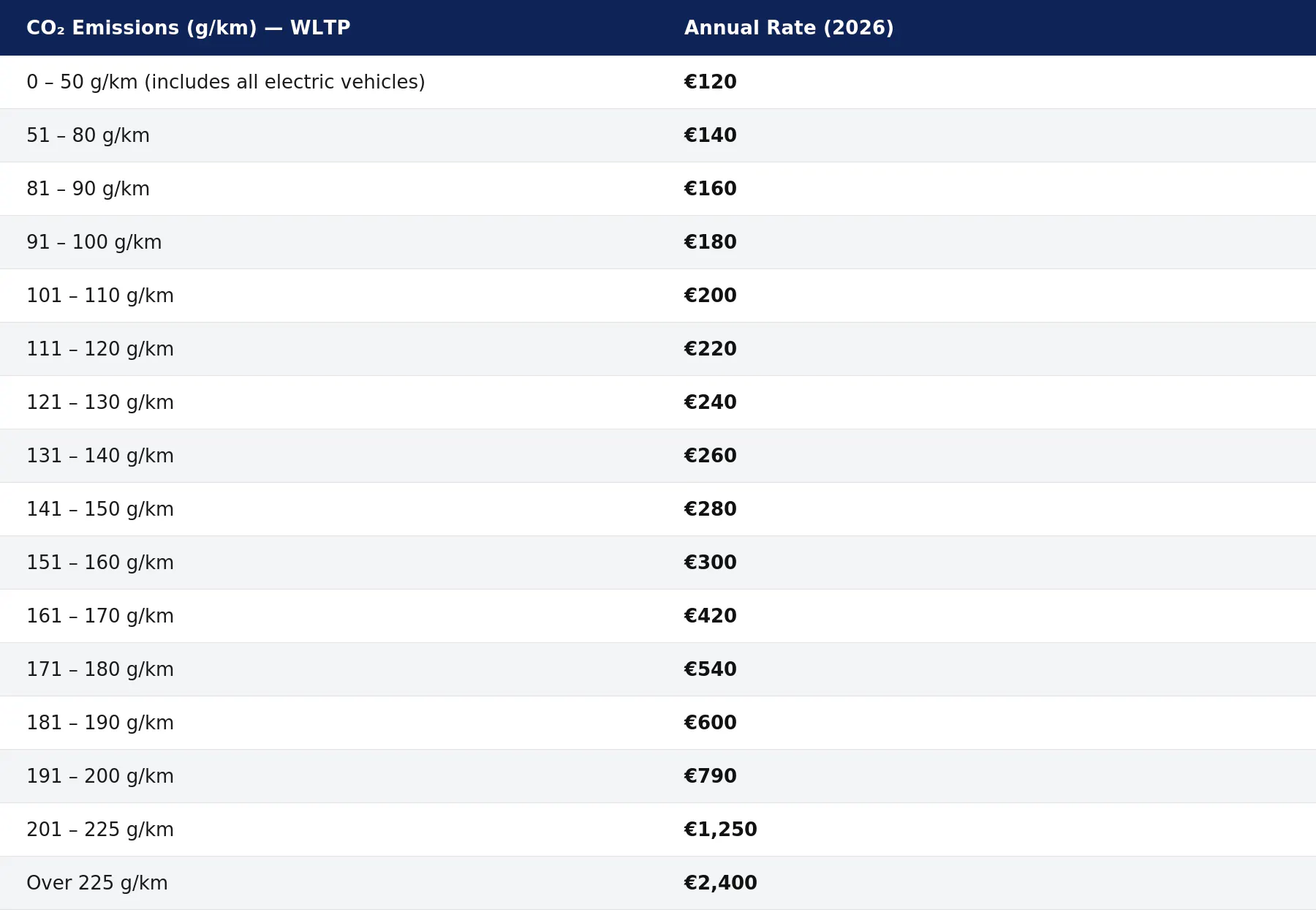
Which Motor Tax System Applies to Your Car?
Ireland uses three different motor tax systems, depending on when your car was first registered anywhere in the world — not just in Ireland.
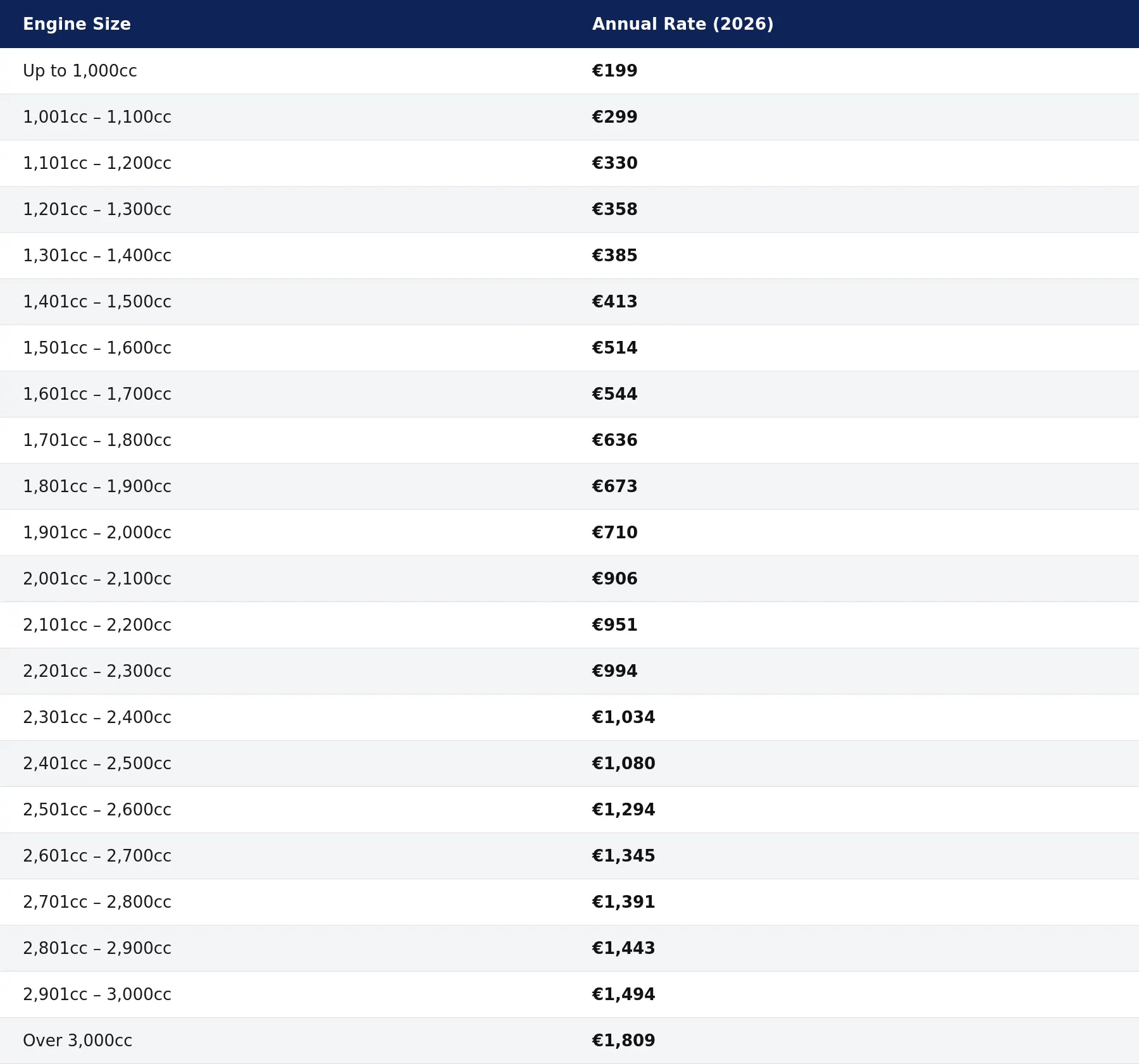
Cars Registered July 2008 – December 2020: CO₂ Rates (NEDC)
Cars first registered between July 2008 and December 2020 are taxed on their official CO₂ emissions, measured in grams per kilometre (g/km) under the older NEDC test procedure. The lower the emissions, the lower the tax.
This system was introduced to encourage buyers to choose more fuel-efficient, lower-emission vehicles. It is why a 2012 diesel hatchback with modest emissions can pay significantly less tax than a larger-engined car from a few years earlier.
One important note: cars originally registered between January and June 2008 on the old engine-size system were subsequently moved across to this CO₂ system. Their CO₂ band stays with the vehicle for life.
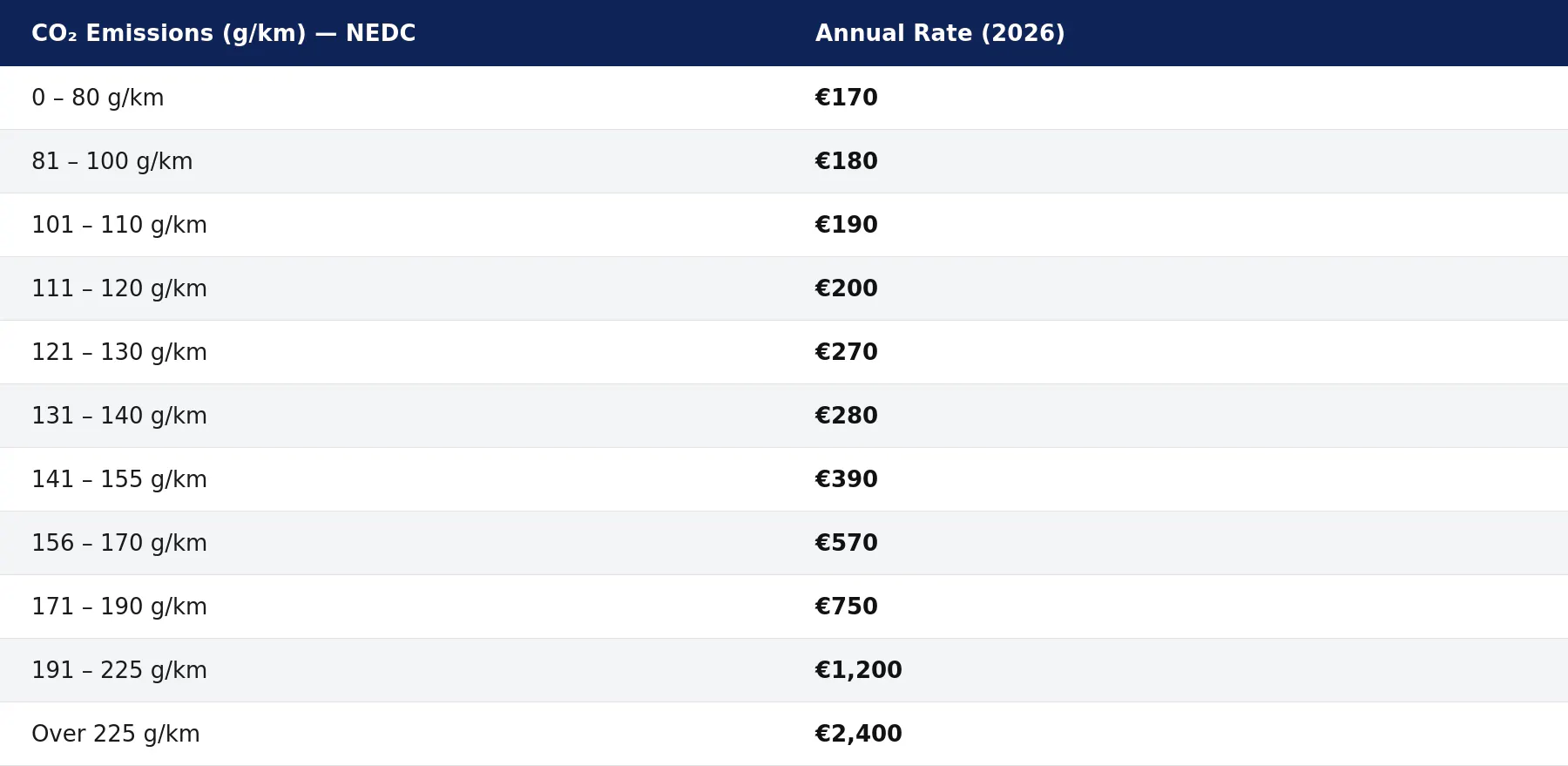

Cars Registered from January 2021: CO₂ Rates (WLTP)
From 1 January 2021, Ireland switched to the WLTP (Worldwide Harmonised Light Vehicle Test Procedure) for calculating motor tax on new cars. WLTP is a more realistic test than the older NEDC procedure — it reflects real-world driving conditions more accurately, which typically means slightly higher official CO₂ figures for the same car.
This is an important distinction for anyone buying a newer car or importing from the UK: a car’s WLTP CO₂ figure will often be higher than its NEDC figure, and it is the WLTP number that determines your Irish motor tax if the car was first registered from January 2021.
Electric vehicles fall into the lowest band because they produce 0 g/km of CO₂. The annual rate for a battery electric vehicle (BEV) is €120 per year — the cheapest motor tax rate available in Ireland.
Motor Tax Rates for Other Vehicles
Electric Vehicles
Battery electric vehicles (BEVs) pay €120 per year — the lowest rate available. This applies regardless of when the EV was first registered, as long as it produces 0 g/km CO₂. Plug-in hybrids are taxed on their official WLTP CO₂ figure, which varies by model.
Motorcycles
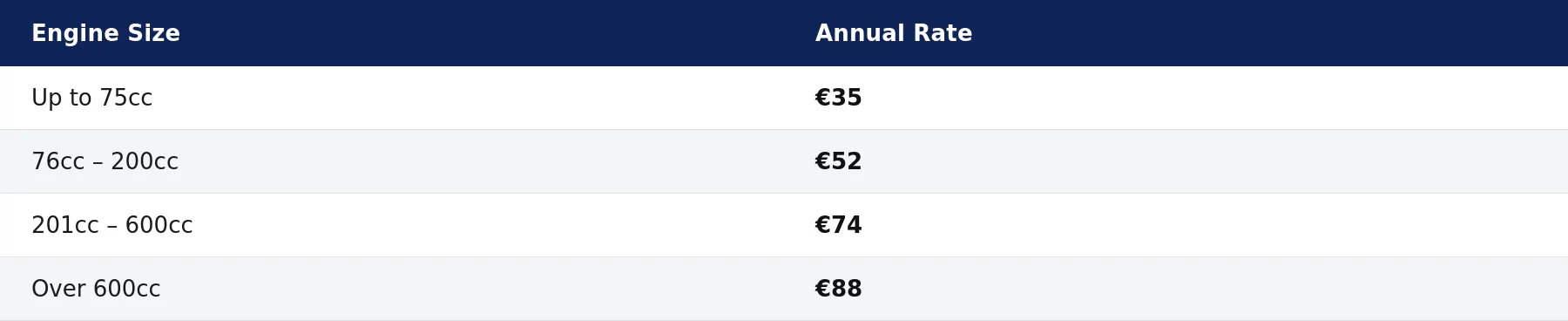
Motorcycles are taxed at a flat rate regardless of engine size. The rates for 2026 are:
Vintage and Classic Vehicles
Vehicles that are 30 or more years old qualify for a special vintage motor tax rate. To qualify, the age of the vehicle must be clearly established from the chassis number and the Vehicle Registration Certificate.

Commercial and Goods Vehicles
Commercial vehicles are taxed on the basis of weight rather than engine size or emissions. The basic private goods rates (for vehicles used privately, not commercially) follow the engine-size bands above. For vehicles used commercially with an unladen weight above 1,524kg, weight-based rates apply. Large commercial vehicles above 4,000kg pay €500 per year; vehicles above 12,000kg pay €900 per year.
How Much Will You Actually Pay? The Surcharge Trap
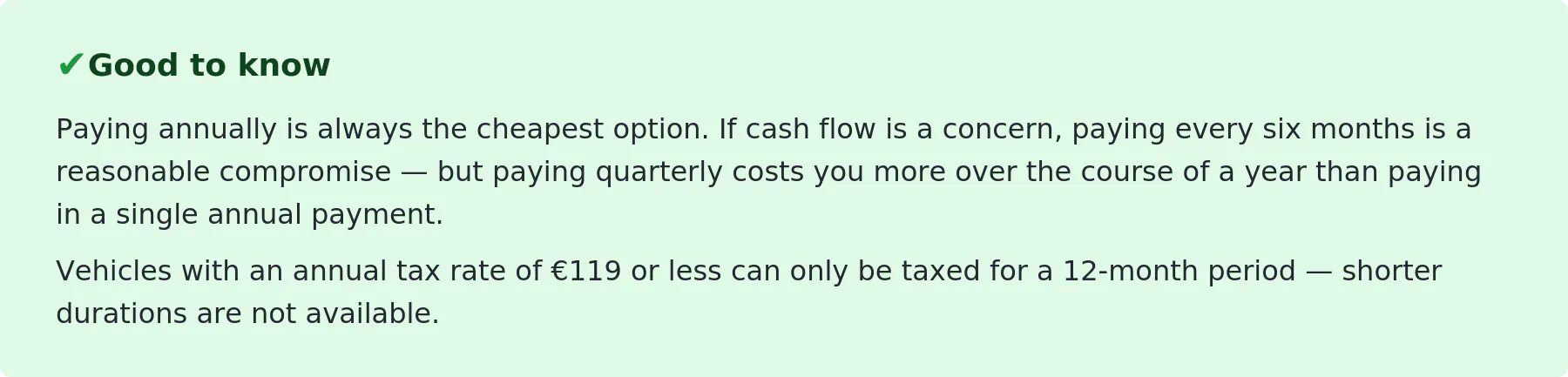
Motor tax can be paid in three different ways: annually, every six months, or every three months. Most people assume the amounts are proportional. They are not — and paying quarterly is the most expensive option per month.

Buying a Used Car: What You Need to Know About Motor Tax
Motor tax is one of the most frequently misunderstood aspects of buying a used car in Ireland. Here are the things that matter most — including several that official sources rarely explain clearly.
Are You Liable for the Previous Owner’s Tax Arrears?
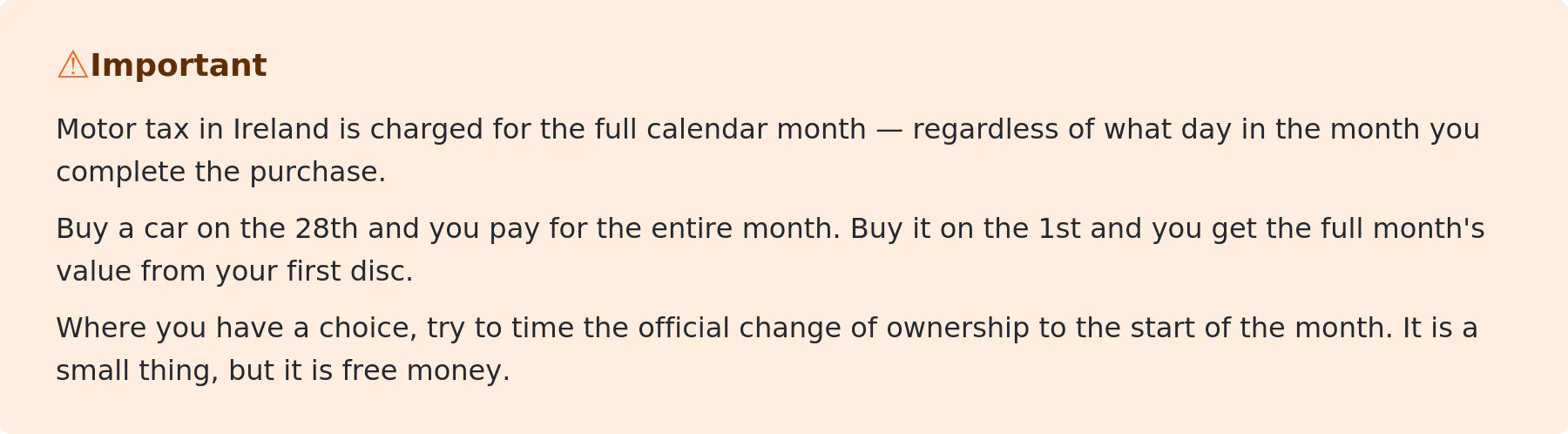
No. This is one of the most common anxieties for used car buyers in Ireland, and the answer is straightforwardly reassuring: when a change of ownership is officially recorded with the Department of Transport, any previous motor tax arrears are cleared. You, as the new owner, are only responsible for taxing the car from the first day of the month in which you purchased it.
You do not inherit the previous owner’s debt. You start fresh.
The Mid-Month Rule: Timing Your Purchase
How to Check if a Car Is Currently Taxed
Before you go to view any used car, you can check its current tax status online. The official motor tax system at motortax.ie allows you to verify whether a vehicle is currently taxed by entering its registration number. This takes about thirty seconds and can tell you immediately whether the seller’s claims about the car’s tax status are accurate.
Make it a standard part of your used car checklist — right alongside checking the NCT status and running a history check.
Changing Ownership: The Online Process
Since 2024, change of vehicle ownership in Ireland can be completed online through the official government portal, using a verified MyGovID account. Both the buyer and seller need a verified MyGovID to complete the transaction in real time. This removes the need to post the Vehicle Registration Certificate (VRC) and speeds up the process significantly.
Once ownership is transferred, you can immediately begin the process of taxing the car in your own name at motortax.ie.
What You Need to Tax a Used Car for the First Time in Your Name
✔ Your vehicle registration number
✔ Your PIN — this is the last six digits of the Vehicle Registration Certificate (VRC) serial number, the number starting with ‘C’ printed at the top right of the VRC
✔ Valid motor insurance (a current Certificate of Insurance is required)
✔ Payment by debit or credit card if taxing online

Importing a Car from the UK or Northern Ireland
Importing a car is a popular route in Ireland, particularly from Northern Ireland and Great Britain. However, there are several steps that must be completed before you can legally drive the car on Irish roads — and motor tax is only one of them.
The Sequence: What Comes Before Motor Tax
You cannot get an Irish motor tax disc until your vehicle has an Irish registration number. And you cannot get an Irish registration number until Vehicle Registration Tax (VRT) has been paid. So the sequence always runs:
- Register the vehicle at an NCTS (National Car Testing Service) centre within 30 days of bringing it into Ireland
- Pay VRT, which is calculated based on the car’s open market selling price and CO₂ emissions
- Receive your Irish registration number
- Tax the vehicle at motortax.ie using the last 6 characters of the chassis number (VIN) as your PIN for first-time taxing
Great Britain Imports: The Post-Brexit Requirements
Since Brexit, importing from Great Britain (England, Scotland, Wales) involves additional steps compared to importing from Northern Ireland. For GB imports, you will need a Master Reference Number (MRN), which is generated from your customs declaration. Without an MRN, you cannot complete the VRT process.
You may also be liable for VAT and customs duty on vehicles imported directly from GB, depending on the vehicle’s origin and history. This can add significantly to the cost. Make sure to factor this into any cross-channel purchase calculation.
Northern Ireland Imports
Northern Ireland remains part of the UK’s customs territory but has a special status under the Windsor Framework. Importing from NI is generally more straightforward than importing from GB — there is no customs duty on cars of UK origin moving from NI to Ireland, and the MRN requirement does not apply in the same way.
However, VRT still applies, and the car must still be registered and taxed in the usual sequence.
The WLTP/NEDC Issue on UK Imports
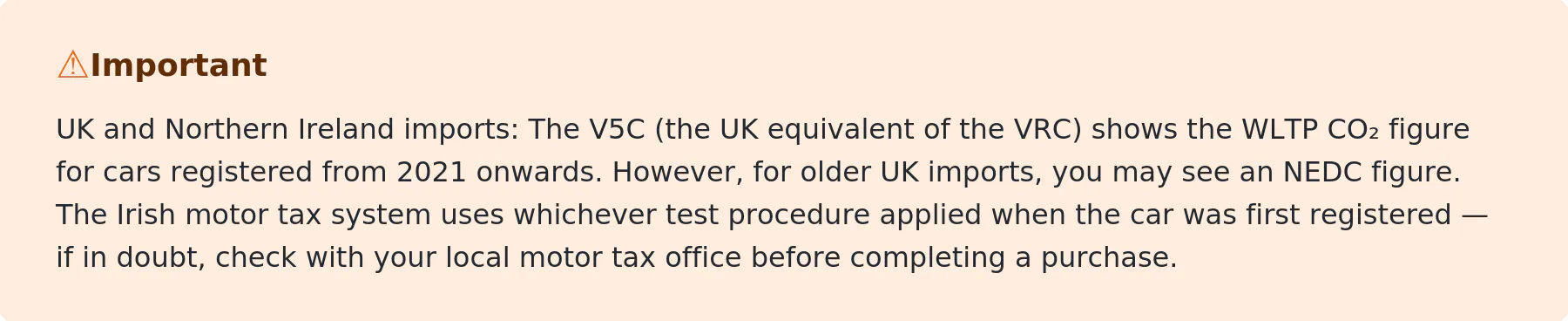
⚠ Important
A car’s UK V5C document shows CO₂ emissions. For cars registered before 2021, this is the NEDC figure. For cars registered from 2021, it is the WLTP figure.
The Irish motor tax system uses whichever test standard applied at the time of first registration. If you are importing a 2022 car, its WLTP figure applies and will determine your motor tax band.
WLTP figures are generally higher than NEDC for the same car. Do not assume a car’s CO₂ figure from an older spec sheet will match what appears on the VRC after Irish registration.
How to Pay Motor Tax
There are three ways to pay your motor tax in Ireland: online, in person at your local Motor Tax Office, or by post. Online is by far the fastest and most convenient option for most people.
Online at MotorTax.ie
MotorTax.ie is available 24 hours a day, 7 days a week. You will need:
✔ Your vehicle registration number
✔ Your PIN (the last six digits of your VRC serial number, starting with ‘C’)
✔ Valid motor insurance
✔ A debit or credit card for payment
If you have not received a renewal notice or cannot find your PIN, you do not need to wait. Your PIN is always the last six digits of the VRC serial number. This is printed on the front of the VRC at the top right.
In Person at Your Local Motor Tax Office
Every local authority in Ireland has a Motor Tax Office. Hours vary, but most operate Monday to Friday during business hours. For first-time taxing of a new car, or if you are unable to use the online system, bring the relevant form and supporting documents in person.
The forms you may need:
- RF100 — for taxing a brand new or newly imported vehicle for the first time (usually provided by the dealer)
- RF100A — for renewing motor tax when you have not received a renewal notice
- RF100B — for renewing using a form issued by the Department of Transport
By Post
You can also renew by post by sending your completed renewal form and payment to your local Motor Tax Office. Allow extra time for processing — typically five to seven working days.
Payment Periods
When paying motor tax, you choose the duration: 3 months, 6 months, or 12 months. As covered in the surcharge section above, paying annually is always the most cost-effective option. Shorter periods incur a surcharge built into the rates.
Declaring Your Car Off the Road
If your vehicle is not going to be used on public roads and will not be kept in a public place, you can declare it officially off the road and avoid paying motor tax for the period it is not in use. This is done using Form RF150, the equivalent of a SORN (Statutory Off Road Notification) in the UK.
Key Rules for Off-Road Declarations
- The declaration must be made in the month your current motor tax disc expires — it cannot be backdated
- The minimum off-road period is three calendar months; the maximum is twelve months
- You cannot declare a vehicle off the road for one or two months only
- Any outstanding motor tax arrears must be cleared, and you must pay at least three months of motor tax before you can make an off-road declaration
How to Declare Off the Road
- Online at MotorTax.ie using your PIN from the renewal notice
- By submitting Form RF150 to your local Motor Tax Office in person or by post
- Form RF150 is available from Motor Tax Offices, Garda stations, libraries, and Citizens Information Centres
⚠ Important
The ‘I forgot’ scenario: If your car has been sitting idle and you forgot to file an RF150 before your disc expired, you are technically in arrears. In this situation, contact your local Motor Tax Office directly. They can advise on your options. Arrears are charged at one-tenth of the annual rate per month, so the longer you leave it, the more it costs.
Exemptions and Refunds
Who Is Exempt from Motor Tax?
A limited number of vehicle categories are exempt from motor tax in Ireland:
- Vehicles adapted for use by disabled drivers or passengers under the Disabled Drivers and Disabled Passengers Tax Concessions Regulations
- State-owned vehicles, including Garda vehicles and CIE buses (these carry a disc showing €0.00)
- Certain emergency and public service vehicles
- Diplomatic vehicles
- Invalid carriages not exceeding 400kg unladen weight
Can I Get a Refund on My Motor Tax?
Yes, in certain circumstances. A refund of unused motor tax is possible if:
- The vehicle has been scrapped or destroyed (requires a certificate of destruction from an authorised facility)
- The vehicle has been permanently exported from Ireland (requires an export confirmation document)
- The vehicle was stolen and not recovered (requires Garda confirmation)
- The owner is unable to use the vehicle due to illness, injury or other physical disability (requires a medical certificate for the remaining period of the disc)
- The owner is absent from the state for business or educational purposes, or is serving overseas with the Irish Defence Forces
✔ Good to know
To be eligible for a refund, a minimum of three unexpired whole calendar months must remain on the disc at the time of application. Refunds are calculated from the first day of the month following surrender of the disc. Use Form RF120 (available from motor tax offices or to download).
Electric Vehicles and the Future of Motor Tax
Battery electric vehicles currently pay €120 per year in motor tax — the lowest rate available, achieved because EVs produce 0 g/km of CO₂ and fall into the lowest WLTP band. This rate was unchanged in Budget 2026.
Will the €120 EV Rate Increase?
Budget 2026 maintained the €120 flat rate for battery electric vehicles. A proposed new weight-based tax for larger SUVs — which would have affected some popular EVs — was discussed during the budget process but was not implemented. The existing emissions-based system remains in place for 2026.
However, it is worth understanding the broader context. As more Irish drivers move to electric vehicles, the government faces a long-term revenue challenge: motor tax income will fall as the fleet electrifies, and fuel excise — another major source of motoring revenue — will also decline. Road Usage Charging, a system where drivers pay per kilometre driven rather than a flat annual fee, has been discussed at policy level as a potential future replacement.
For now, motor tax remains an annual fixed fee. No per-kilometre charge has been introduced or legislated for. But EV buyers should be aware that the €120 rate reflects current government policy rather than a permanent structural guarantee — and that policy can change.
Penalties for Driving Without Motor Tax
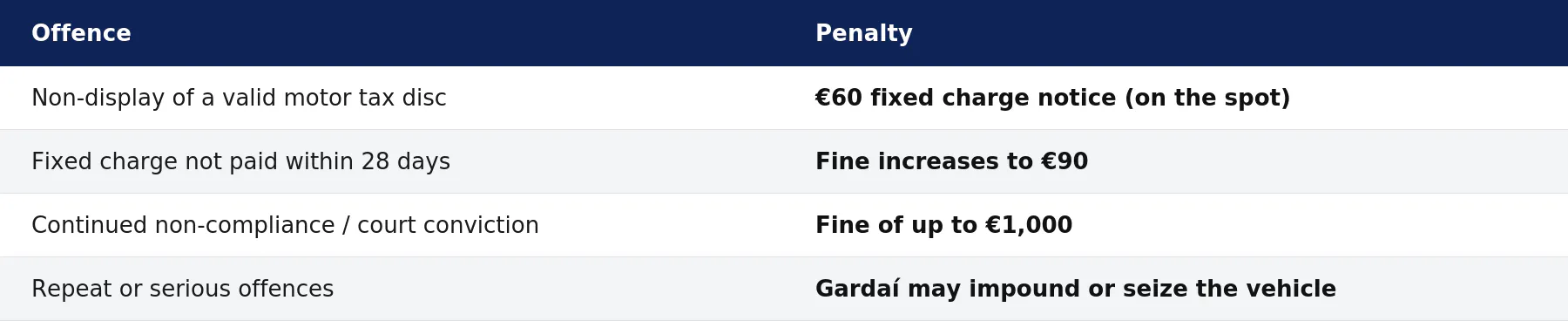
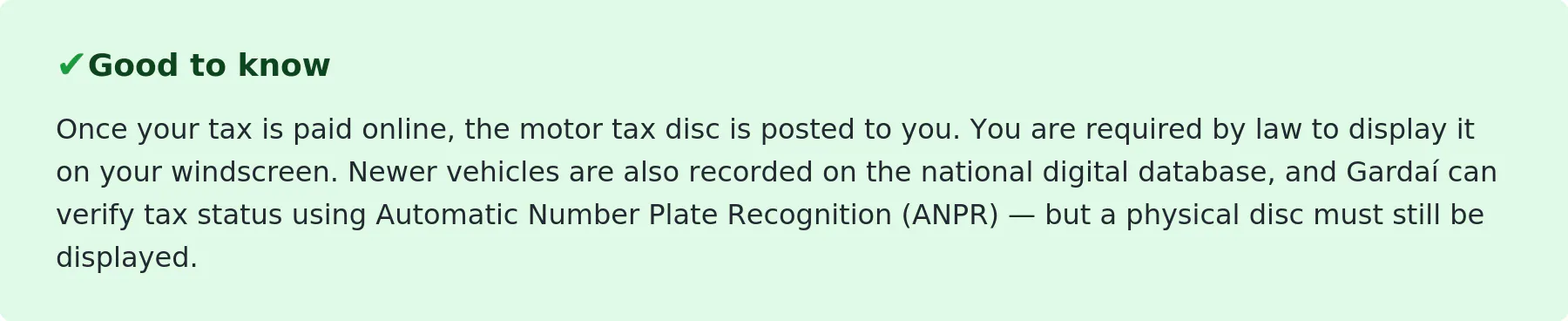
Gardáí can check motor tax status instantly using Automatic Number Plate Recognition (ANPR) cameras, without needing to stop the vehicle. Even if your car is parked on a public road without a valid tax disc displayed, you can receive a fixed charge notice.
Frequently Asked Questions
Am I liable for motor tax arrears if I buy a second-hand car?
No. When a change of ownership is officially recorded with the Department of Transport, any previous motor tax arrears are cleared. As the new owner, you are only responsible for taxing the vehicle from the first day of the month in which you purchased it. You do not inherit the previous owner’s debt.
I bought a car on the 29th of the month — do I have to pay for the full month?
Yes. Motor tax in Ireland is charged for the full calendar month regardless of the day you complete the purchase. If you have flexibility in timing, completing the change of ownership on the first of the month means you get the full month’s value from your first disc.
How do I tax a car imported from the UK or Northern Ireland?
You cannot tax the vehicle until Vehicle Registration Tax (VRT) has been paid and an Irish registration number has been issued. Register at an NCTS centre within 30 days of import, pay VRT, receive your Irish registration, then tax at motortax.ie using the last 6 characters of the chassis number as your PIN for the first payment. For GB imports, you will also need a Master Reference Number (MRN) from your customs declaration.
Can I tax my car if it hasn’t passed its NCT?
Yes, currently MotorTax.ie does not block you from paying motor tax if your NCT has expired. However, driving a vehicle without a valid NCT is a separate offence and you can be fined for it independently. Paying motor tax on an unroadworthy car does not make it legal to drive.
Will the €120 electric vehicle motor tax rate increase?
Budget 2026 kept the €120 flat rate for battery electric vehicles unchanged. A proposed weight-based tax for larger SUVs was discussed but not implemented. The rate may be reviewed in future budgets — follow the annual October budget announcement for any changes.
What if I don’t have a renewal PIN?
You do not need to wait for a renewal notice in the post. Your PIN is always the last six digits of your Vehicle Registration Certificate (VRC) serial number — the number that starts with ‘C’, printed at the top right of your VRC. You can enter this directly on motortax.ie.
Why is my car ‘Not Found’ on the motor tax website?
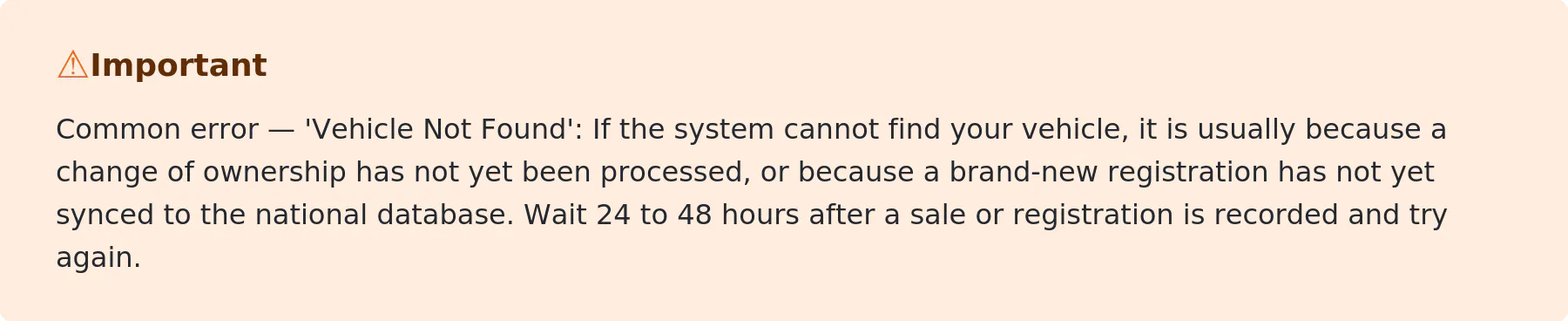
This usually happens if a dealer has not yet processed the change of ownership, or if a brand-new registration has not yet synced to the national database. Wait 24 to 48 hours after the sale or registration is recorded and try again. If the problem persists, contact your local Motor Tax Office.
How do I declare my car off the road?
Submit Form RF150 to your local Motor Tax Office, or complete the declaration online at motortax.ie using your PIN. The declaration must be made in the month your current motor tax disc expires — it cannot be backdated. The minimum off-road period is three months and the maximum is twelve months.
Can I get a motor tax refund?
Yes, in certain circumstances: if the vehicle is scrapped, permanently exported, stolen and not recovered, or if you are unable to use it due to illness or absence from the state. A minimum of three unexpired whole calendar months must remain on the disc at the time of application. Use Form RF120 and surrender the disc to your motor tax office.
What is the fine for driving without motor tax in Ireland?
Gardáí can issue an on-the-spot fixed charge notice of €60 for non-display of a valid motor tax disc. If unpaid after 28 days the fine rises to €90. Continued non-compliance can result in court fines of up to €1,000, and in serious cases Gardáí have the power to impound your vehicle.
How much is motor tax for a vintage car in Ireland?
Vehicles 30 or more years old qualify for a special vintage motor tax rate of €56 per year for cars, or €26 per year for motorcycles. The vehicle’s age must be clearly established from the chassis number and the Vehicle Registration Certificate. At time of writing, this applies to vehicles first registered in 1995 or earlier.
Is motor tax cheaper if I pay annually?
Yes. Paying for 12 months is always the most cost-effective option. Six months costs 55.5% of the annual rate, and three months costs 28.25% — meaning quarterly payers spend more overall than those who pay in a single annual payment. The surcharge is built into the shorter-period rates.
Is motor tax the same as VRT (Vehicle Registration Tax)?
No, they are two separate charges. VRT is a one-off tax paid when a vehicle is first registered in Ireland — either by the dealer on a new car, or by the importer when bringing a vehicle into the country. Motor tax is the annual recurring charge you pay to use the vehicle on public roads. Both must be paid, but they are completely separate.