
Used Electric Car Prices in Ireland Are Rising Again — What the H1 2026 Price Index Shows

Used EV values rose 2.0% year on year and 0.6% quarter on quarter to July 2026. That may sound modest, but the comparison across fuel types is what matters: the main petrol and diesel (ICE) index rose 1.1% over the same twelve months, and hybrids rose 1.5%. For the first time since the index began tracking a downturn in 2023, electric is now outperforming both.
ℹ️ DoneDeal insight: Price index movements are the strongest determinant of depreciation. If used EV prices are rising faster than diesel and hybrid, it means electric cars are now holding their value better too — a reversal of what buyers have experienced for the past three years.
Why did used EV prices fall so much between 2023 and 2025?
Used EV prices fell because new car discounting and grant reductions collided with a second-hand supply glut, and that oversupply took three years to clear. The decline began in 2023, continued through a sharp 2024, and flattened out over 2025 without reversing. Annual falls of close to 13-16% were common in that period — this report notes a 12.9% annual fall in the equivalent period of 2024, and the press release cites a 16.4% annual fall as of July 2024.
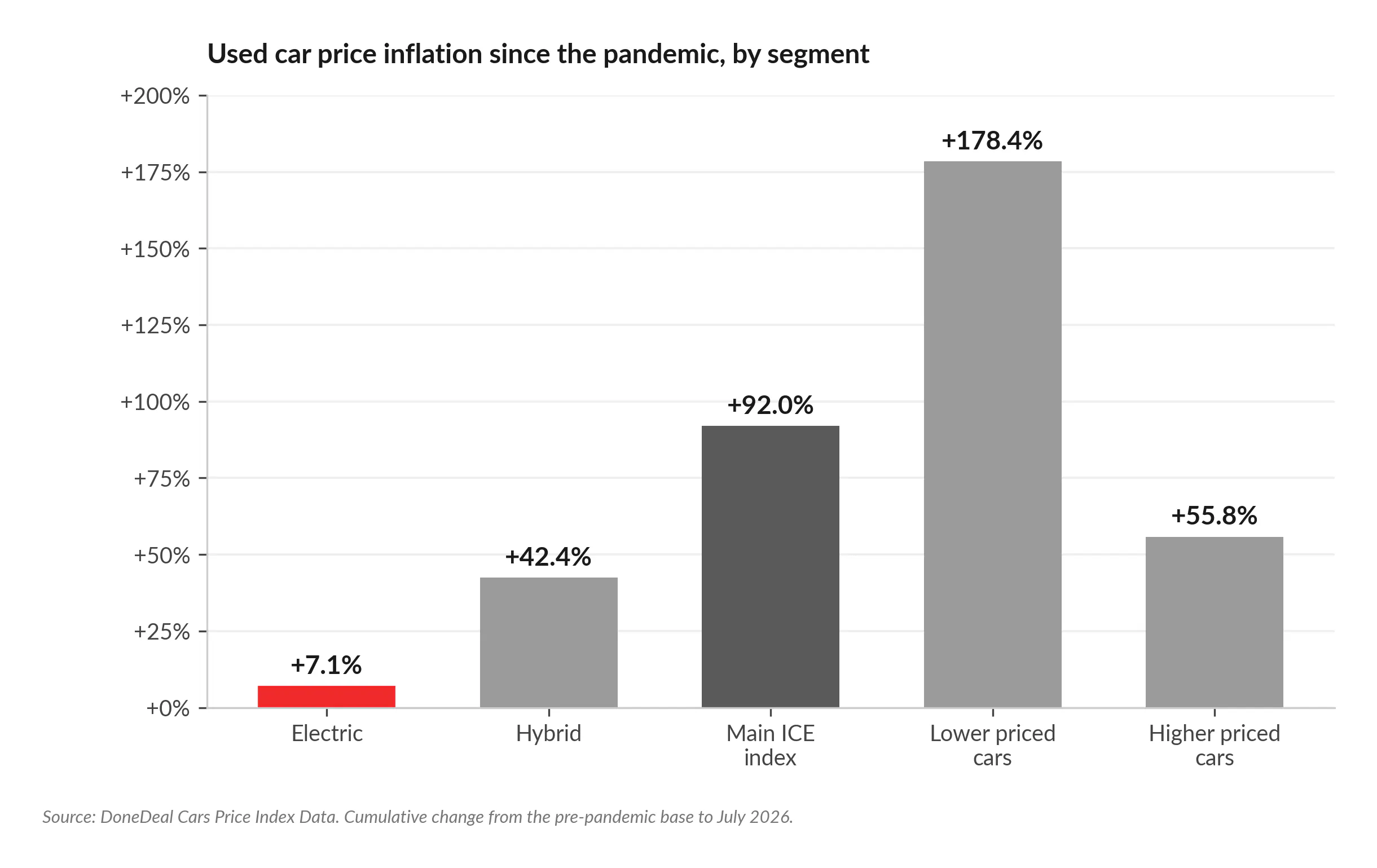
The scale of that correction is easy to lose sight of now that prices are rising again. Since the pandemic, used electric values are up just 7.1% in total. Over the same stretch, hybrids are up 42.4% and the main ICE index is up 92.0%. Electric cars gave back almost all of the pandemic-era price inflation that every other fuel type kept. The current recovery is real, but it is a recovery from a very low bas
How much cheaper is a used EV than an equivalent diesel or hybrid right now?
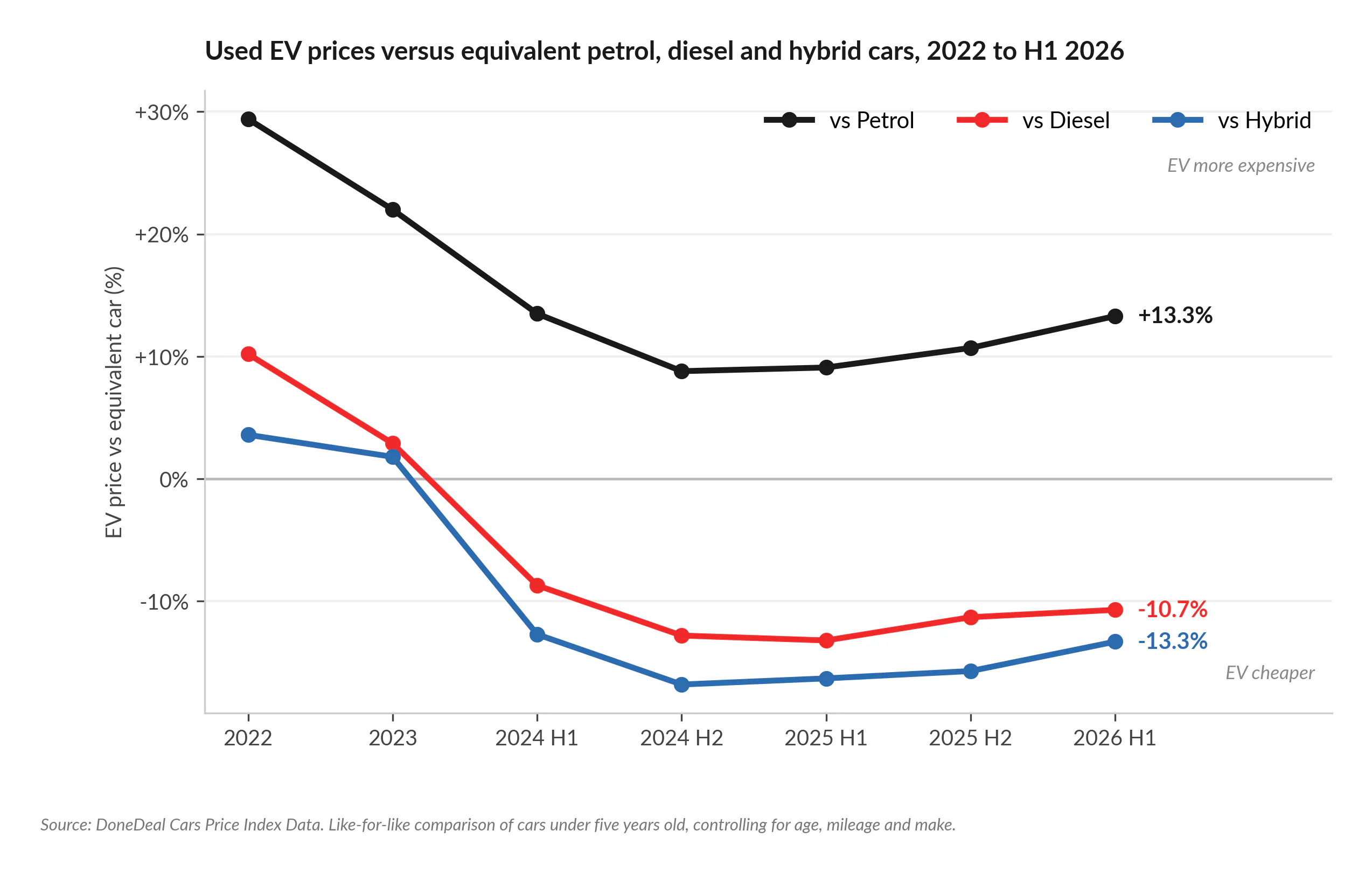
A used electric car still costs 10.7% less than a like-for-like diesel and 13.3% less than an equivalent hybrid, though both discounts have narrowed since the second half of 2025. This comparison controls for age, mileage and make across cars under five years old, so it isolates the powertrain effect rather than comparing different types of car.
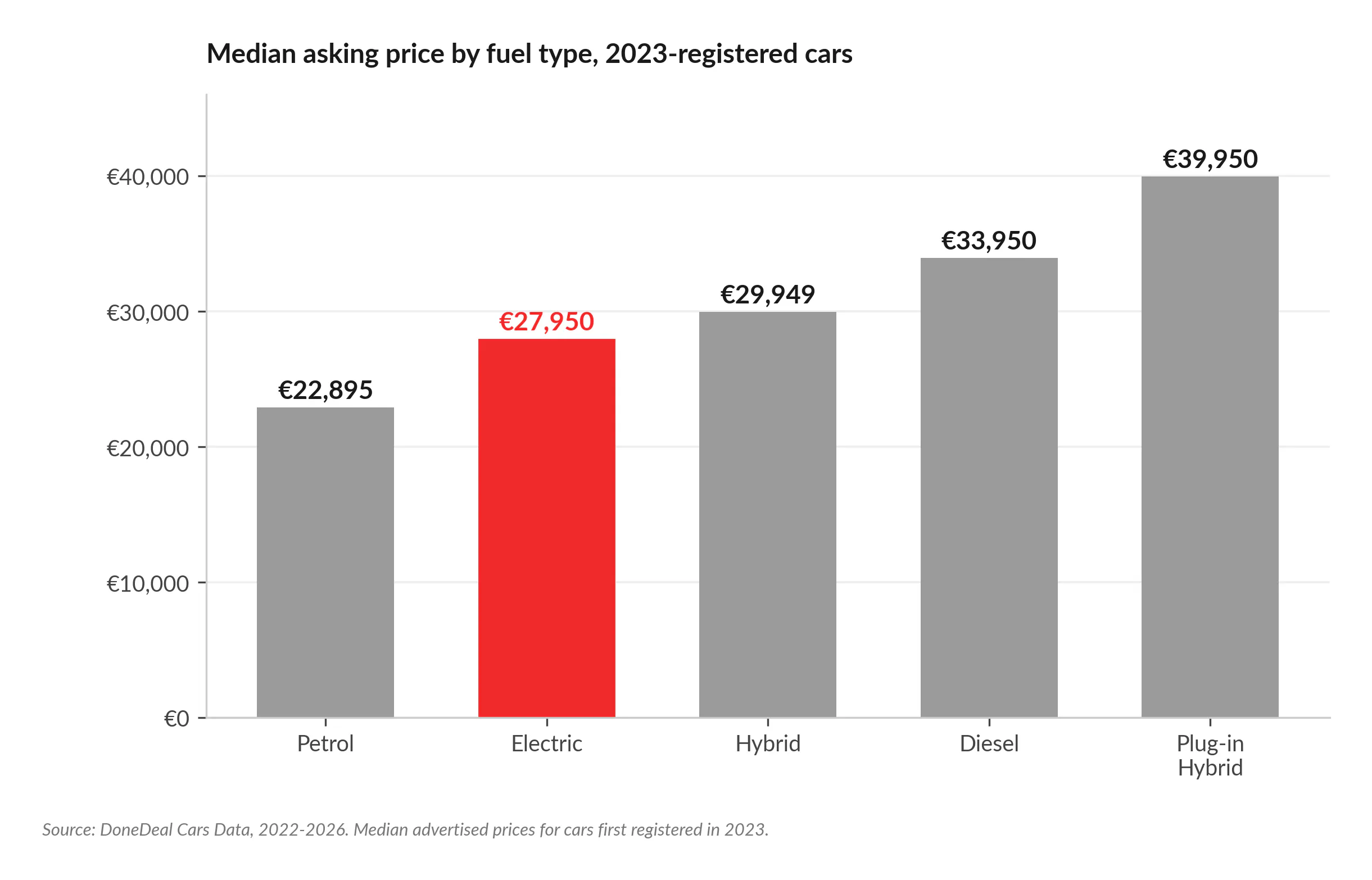
Looking at raw median prices tells the same story from a different angle. For cars first registered in 2023, the medians are:
- Petrol: €22,895 (the cheapest route into a three-year-old car)
- Electric: €27,950
- Hybrid: €29,949
- Diesel: €33,950
- Plug-in hybrid: €39,950 (skewed upward by its concentration in larger, premium models)
Against petrol specifically, the picture is less favourable for EV buyers. Electric carried a 29.4% premium over comparable petrol models back in 2022. That premium compressed sharply — down to 8.8% by the second half of 2024 — but has since widened again to 13.3% as electric values recovered. Even at that level, cheaper fuel and servicing typically recover the extra cost within a normal ownership period, which tips total cost of ownership in favour of electric earlier than it did three years ago.
ℹ️ DoneDeal insight: The premium against petrol and the discount against diesel are moving in the same direction — both reflect EV prices recovering. If you're cross-shopping fuel types, the diesel-versus-electric comparison is the one that has flipped fastest.
Is now a good time to buy a used electric car in Ireland?
For buyers, yes — this is arguably the best-value entry point the used EV market has offered since 2022, because prices fell far enough to create genuine choice at accessible values, and those values are now stable rather than falling. As Paddy Comyn, Head of Automotive Content and Communications at DoneDeal Cars, put it: "Prices had to fall this far before a healthy second-hand electric market could take shape, and it has now taken shape. Buyers who were priced out in 2022 have real choice at accessible values, and they are buying a car that is holding its value rather than losing it. That combination is what turns early adoption into mainstream adoption."
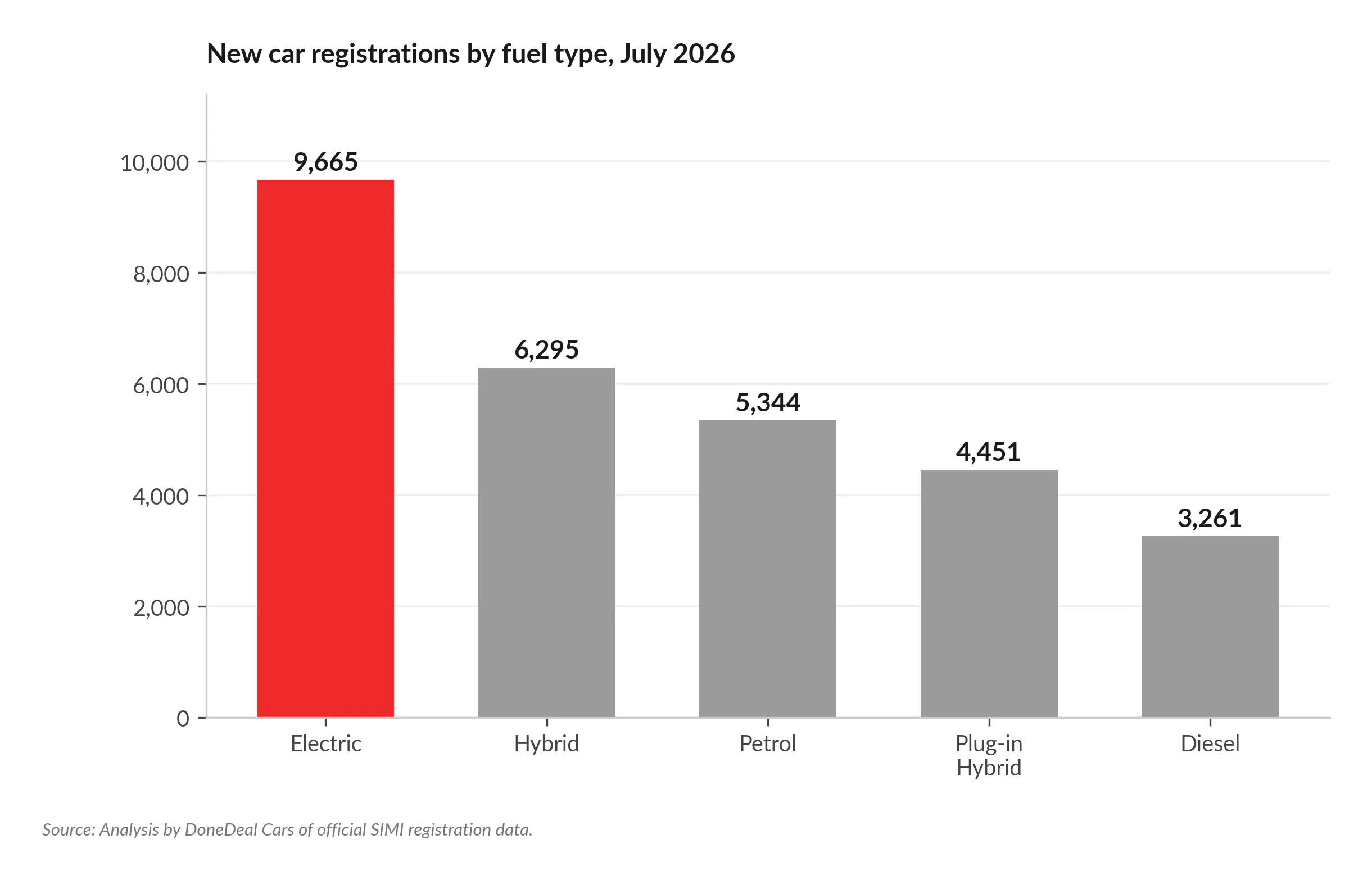
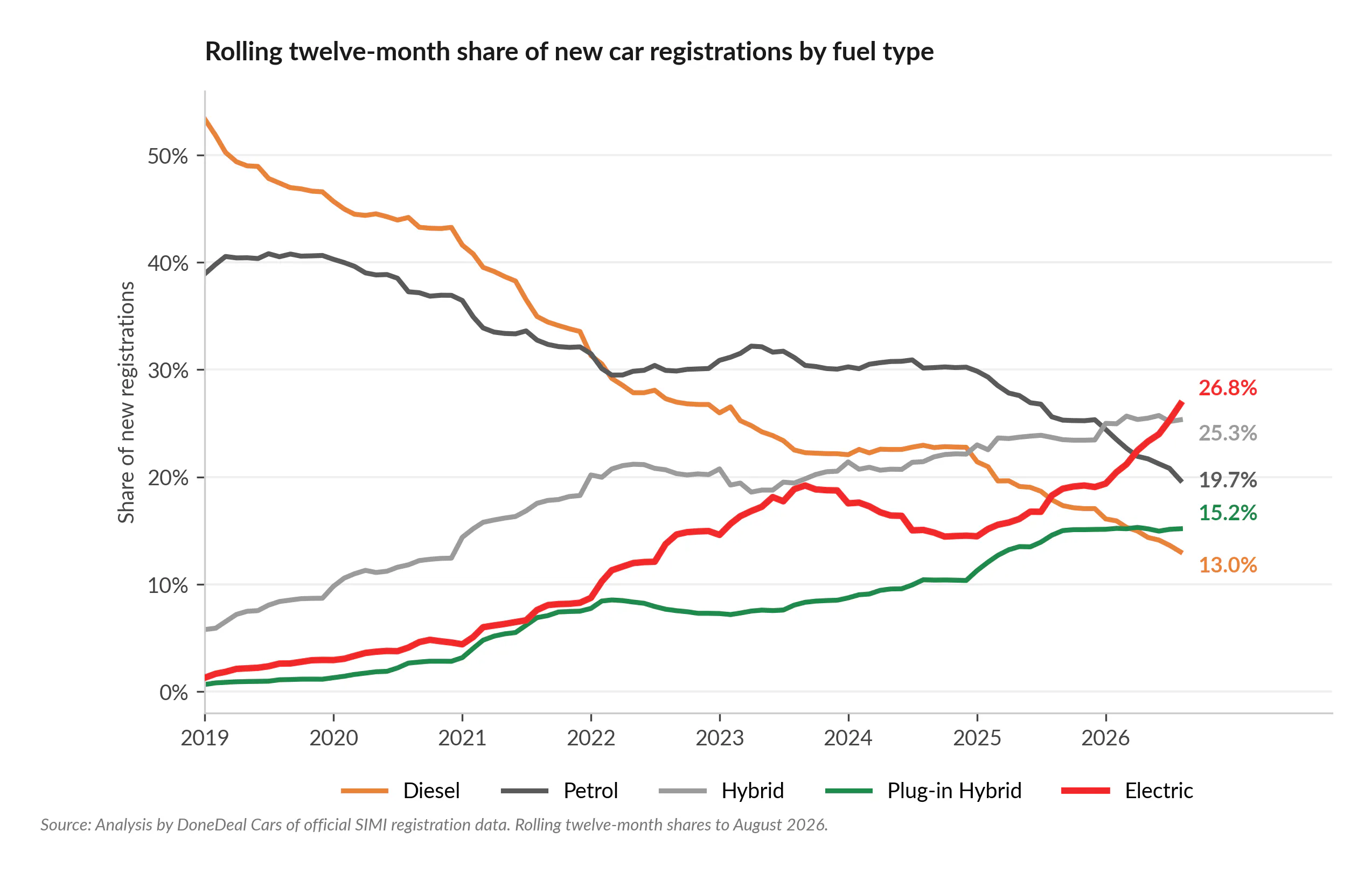
The demand-side data backs this up. In July, 9,665 new electric cars were registered in Ireland — more than hybrids (6,295), petrol (5,344), plug-in hybrids (4,451) or diesel (3,261). Measured on a rolling twelve-month basis to smooth out the seasonal registration-plate cycle, electric reached 25.3% of the new car market in July, narrowly ahead of hybrid at 25.2% — the largest single share for any fuel type for the first time. Electric passed petrol in April and hybrid in July; including August registrations to date, the rolling share is 26.8%.
Search activity on DoneDeal Cars mirrors the trend. Searches filtered to electric ran 114.5% above their August 2025 level in April, 96.1% above in June, and 66.6% above in August. Diesel remains the single most-searched fuel type, but its share is falling steadily.
What's happening in the wider used car market?
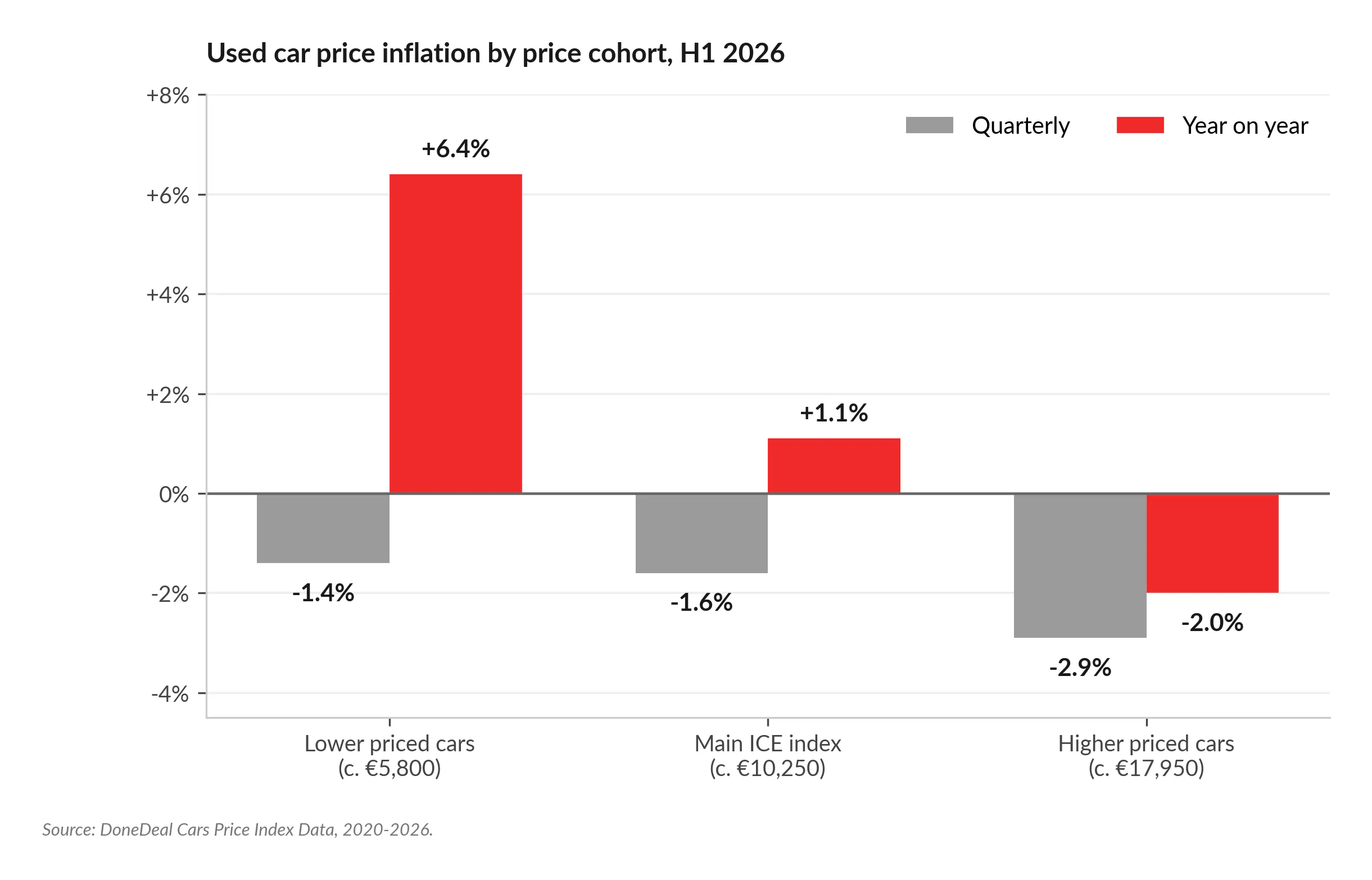
The wider petrol and diesel market has settled into something close to equilibrium, but that headline figure hides a sharp divergence by price. The main ICE index rose 1.1% over the year and eased 1.6% over the quarter — a marked cooling from the 3.5% annual growth reported in the previous index.
Underneath that, the cheapest cars are getting more expensive while the priciest ones are getting cheaper. Cars in the lower-priced tier (median around €5,800) appreciated 6.4% over twelve months, as supply at that end of the market remains scarce. Cars in the higher-priced tier (median around €17,950) fell 2.0% over the same period. Affordability pressure in the Irish used car market is now concentrated firmly at the bottom, not the top.
New car supply continues to support the market overall: registrations reached 124,955 in 2025, 3% ahead of 2024, and the first half of 2026 delivered 85,165 — a 4.2% improvement on the same period last year, driven mainly by a strong second quarter.
What does this actually mean for a real car?
Index percentages are easier to understand against an actual car, so the report tracks four Audi A4s of different ages, applying normal age-related depreciation to see what each should have lost, and comparing that to what it actually fetched a year later.
A 2010 A4 worth €3,654 in July 2025 would have been expected to fall to €3,210 by July 2026 under normal depreciation. It actually held its value at €3,458 — about 8% above expectation — costing its owner just €196 over the year. At the other end, a 2022 A4 worth €37,255 was expected to settle at €32,586 and came in almost exactly there, at €32,610 — still €4,645 of value lost in twelve months, but bang in line with what depreciation models would predict.
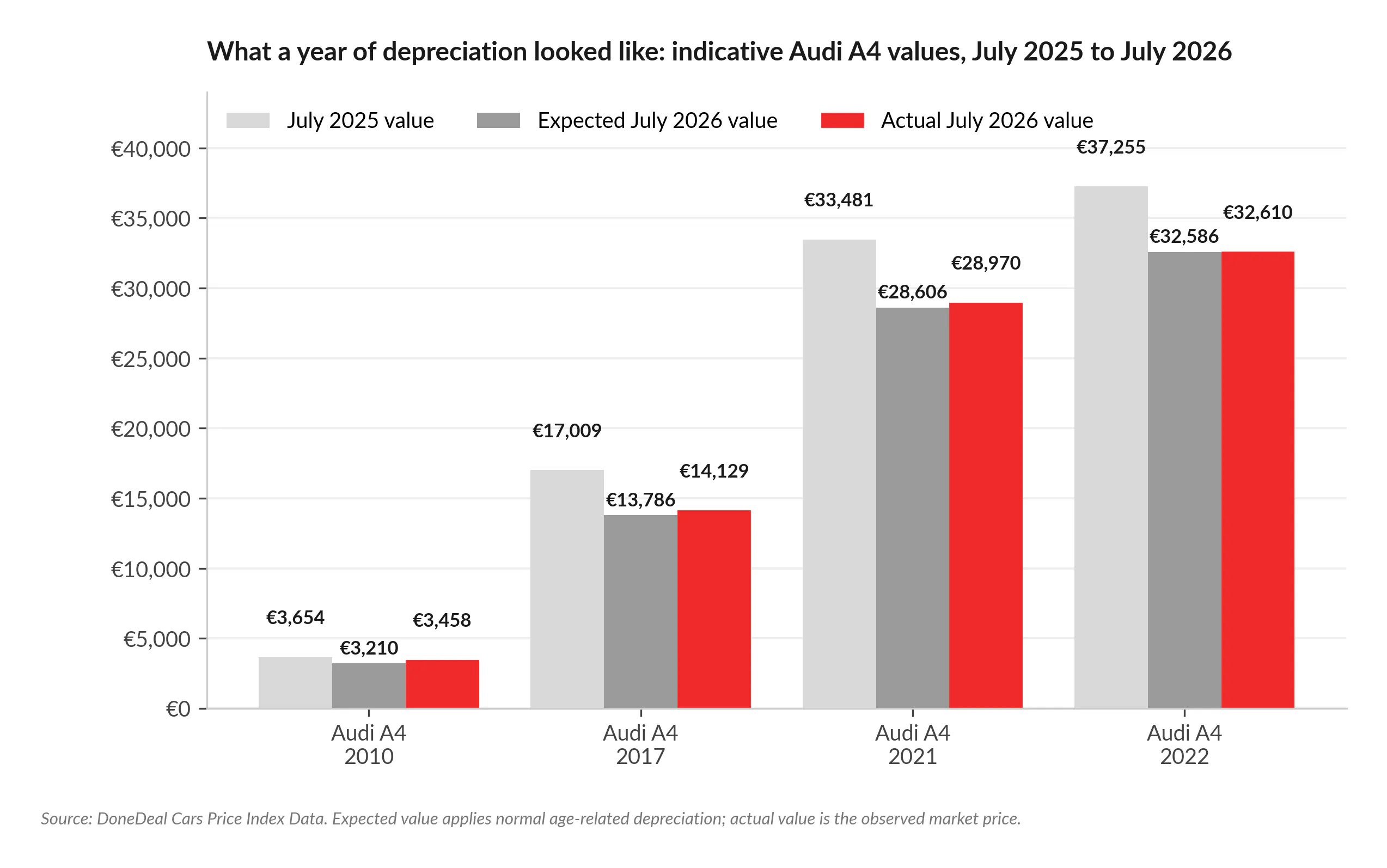
The pattern holds across the board: older, cheaper cars are outperforming what depreciation alone would predict, because supply at that end of the market is genuinely tight. Newer, more expensive cars are depreciating roughly as expected, which — after several years of unusually strong residual values — is itself a return to something more normal.
Why are Irish used imports increasingly coming from Japan rather than the UK?
Irish used imports are increasingly coming from Japan because Brexit made UK imports significantly more expensive through tariffs and VAT, and that lost volume has been replaced from elsewhere — mostly Japan. UK supply, which accounted for more than 108,000 vehicles and a 95% share of Irish used imports as recently as 2019, fell to 12,847 units and an 18% share in 2025, and to just 8,475 units and 14% in the first half of 2026.
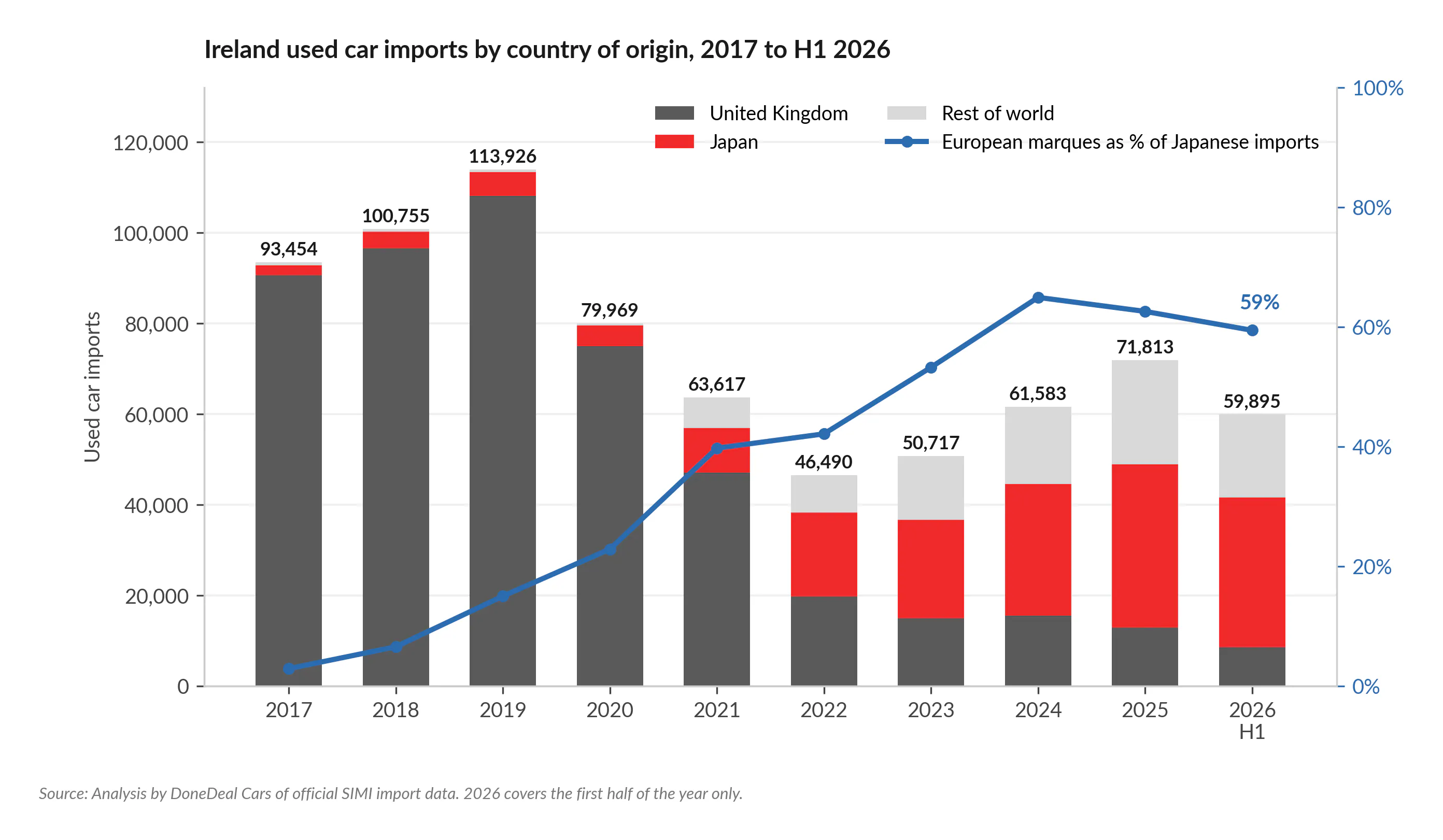
Total import volumes, however, have not fallen — they've recovered strongly. Some 71,813 vehicles arrived in 2025, and the first six months of 2026 alone accounted for 59,895, a pace that would comfortably surpass any full year since 2020.
Japan has filled the gap. Japanese imports numbered just over 5,000 in 2019, a 4.6% share of the total. By 2025 they had reached 36,043 vehicles and half the market, and in the first half of 2026 they accounted for 33,065 vehicles and 55% of all Irish used imports.
The composition of that Japanese trade is the more surprising detail. European marques — overwhelmingly German premium models originally sold new into Japan and now re-exported to Ireland — made up 63% of Japanese-sourced imports in 2025, easing slightly to 59% in the first half of 2026. Volkswagen alone accounted for 10,996 cars imported from Japan in 2025, almost twice as many as Toyota's 6,209 — making a German brand the single largest make arriving from Japan.
ℹ️ DoneDeal insight: If you're browsing a used German saloon on DoneDeal Cars with a Japanese import history, that's not an anomaly — it's now one of the most common routes a European-badged used car takes into Ireland.
Are imported cars getting cleaner or dirtier?
Overall, imported cars are neither noticeably cleaner nor dirtier than they were three years ago — the average emissions of an imported used car sat at 115g CO₂/km in 2023 and 114g CO₂/km in the first half of 2026, essentially unchanged. But that headline figure hides two opposite trends cancelling each other out.
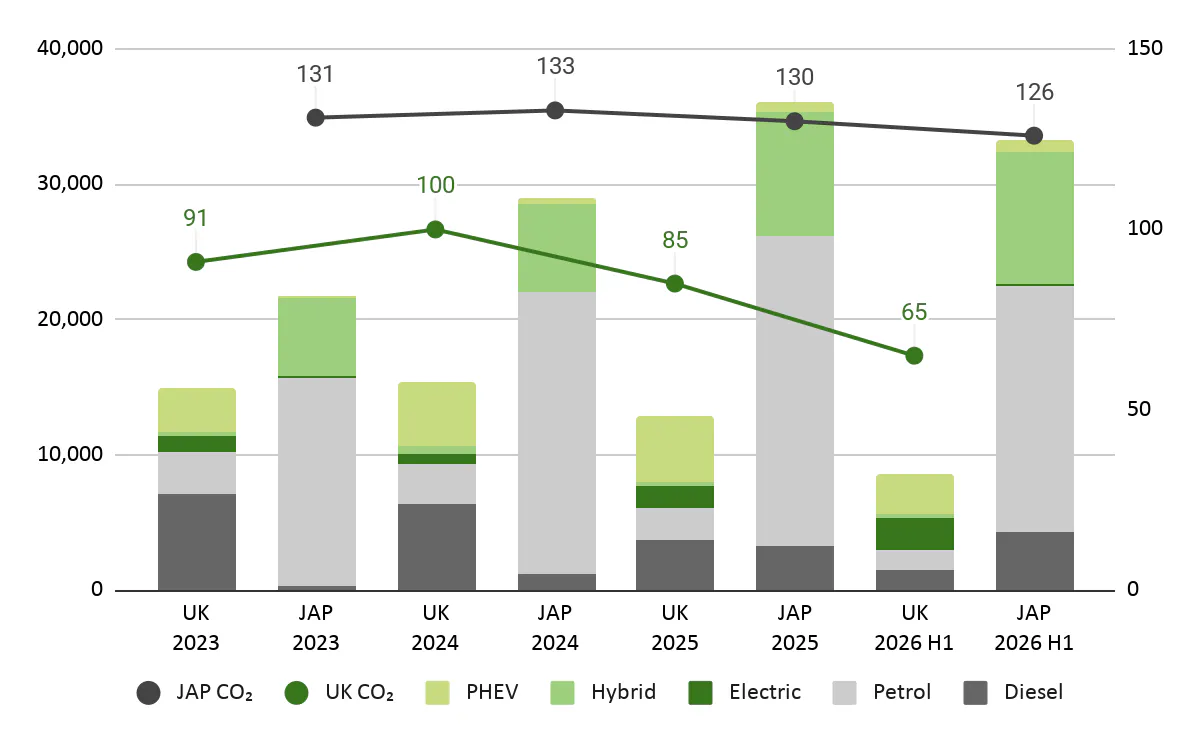
Because Vehicle Registration Tax (VRT) is banded on CO₂ emissions, the duty and VAT burden on UK-sourced stock is now only worth absorbing at the cleanest end of the range. The surviving UK trade reflects that precisely: diesel has fallen from 47% of UK imports in 2023 to 18%, electric and plug-in hybrid together now make up 63% of UK imports, and average emissions from UK stock have dropped from 91g to 65g CO₂/km.
Japanese supply carries no such filter, because there's little diesel in the domestic Japanese market to begin with. Petrol and hybrid still make up 84% of arrivals from Japan, battery-electric is effectively absent at 0.5%, and average emissions have moved only from 131g to 126g CO₂/km.
As Paddy Comyn summarised it: "The Brexit story is finished, and this is the settlement. We import as many used cars as we ever did, but they come from Tokyo rather than Manchester, and a striking share of them are German cars taking the long way round. The environmental irony is worth noting: the small number of British cars still coming in are far cleaner than they were, because VRT makes it uneconomic to import anything else, while the Japanese trade faces no such filter because of the general absence of diesel in the Japanese market. Net of the two, the average imported car is no cleaner than it was three years ago."
What is the DoneDeal Cars Price Index and how is it calculated?
The DoneDeal Cars Price Index is an independent, third-party economic analysis of DoneDeal Cars listings data, produced by economist Dr Tom Gillespie. As DoneDeal Cars lists roughly 9 out of every 10 cars advertised online by Irish dealerships, the dataset is large enough to track pricing trends with real statistical confidence — more than five million vehicle listings from 2011 to 2026 were analysed for this report.
The methodology uses hedonic regression analysis to isolate the price inflation associated with a given vehicle after controlling for mileage, age, and other vehicle attributes — meaning the index reflects genuine market movement, not just a shift in the mix of cars being sold. Electric and hybrid vehicles are indexed separately from the main ICE index, which itself is reported as a whole and split into lower- and higher-priced tiers. No cookies or users' personal data form any part of the analysis; the underlying data is aggregated at the level of the ad — its fuel type, make, model and location.
FAQs
Why did used EV prices in Ireland fall for three years?
Used EV prices fell between 2023 and 2025 because heavy new-car discounting and reduced government grants pushed down new EV prices just as a wave of early adopters brought their used electric cars to market at the same time, creating an oversupply that took three years to clear. That correction has now run its course, and used EV prices are rising again as of H1 2026.
Is a used electric car cheaper to buy than a used diesel in Ireland?
Yes. On a like-for-like basis controlling for age, mileage and make, a used electric car costs about 10.7% less than an equivalent diesel and 13.3% less than an equivalent hybrid as of H1 2026. It does, however, carry a 13.3% premium over a comparable petrol car, because petrol remains the cheapest fuel type to buy used.
Will used EV prices keep rising, or is this a one-off blip?
No index can guarantee a trend will continue, but the underlying demand data — record new EV registrations, EV's largest-ever share of the new car market, and a big jump in EV-filtered searches on DoneDeal Cars — all point the same direction as the price data. The recovery is also happening from an unusually low base, with used EV values up only 7.1% since the pandemic against 92.0% for the main ICE index, suggesting there is more room to run before EV pricing looks stretched.
Why are so many used imports to Ireland now coming from Japan instead of the UK?
Brexit added tariffs and VAT to cars imported from the UK, which made the previously dominant UK import route far less economical. Japan filled that gap: its share of Irish used imports rose from 4.6% in 2019 to 55% in the first half of 2026, and a majority of those Japanese-sourced imports are actually European — mostly German — cars that were originally sold new in Japan and are now being re-exported to Ireland.
Does buying a Japanese-imported German car mean lower emissions?
Not necessarily. Japanese-sourced imports are overwhelmingly petrol or hybrid — battery-electric is effectively absent at 0.5% of Japanese imports — with average emissions around 126g CO₂/km. By contrast, the smaller volume of remaining UK imports is heavily skewed toward electric and plug-in hybrid (63% of UK imports) because VRT bands make importing high-emission UK stock uneconomical, bringing average UK-import emissions down to 65g CO₂/km.
Which segment of the used car market is rising fastest in Ireland right now?
Cars priced under about €6,000 are rising fastest, up 6.4% year on year, because supply at that end of the market is scarce. Cars priced above roughly €20,000 actually fell 2.0% over the same period. Used electric cars, at 2.0% year-on-year growth, are outperforming the main ICE index (1.1%) and hybrids (1.5%), but still trail the pace of the cheapest ICE segment.
Where does the data in the DoneDeal Cars Price Index come from?
It comes from an independent economic analysis by Dr Tom Gillespie of more than five million vehicle listings on DoneDeal Cars, Ireland's largest car marketplace, spanning 2011 to 2026. Registration and import figures are drawn separately from official SIMI data, analysed by DoneDeal Cars.