
Volkswagen Passat R-Line TDI Review

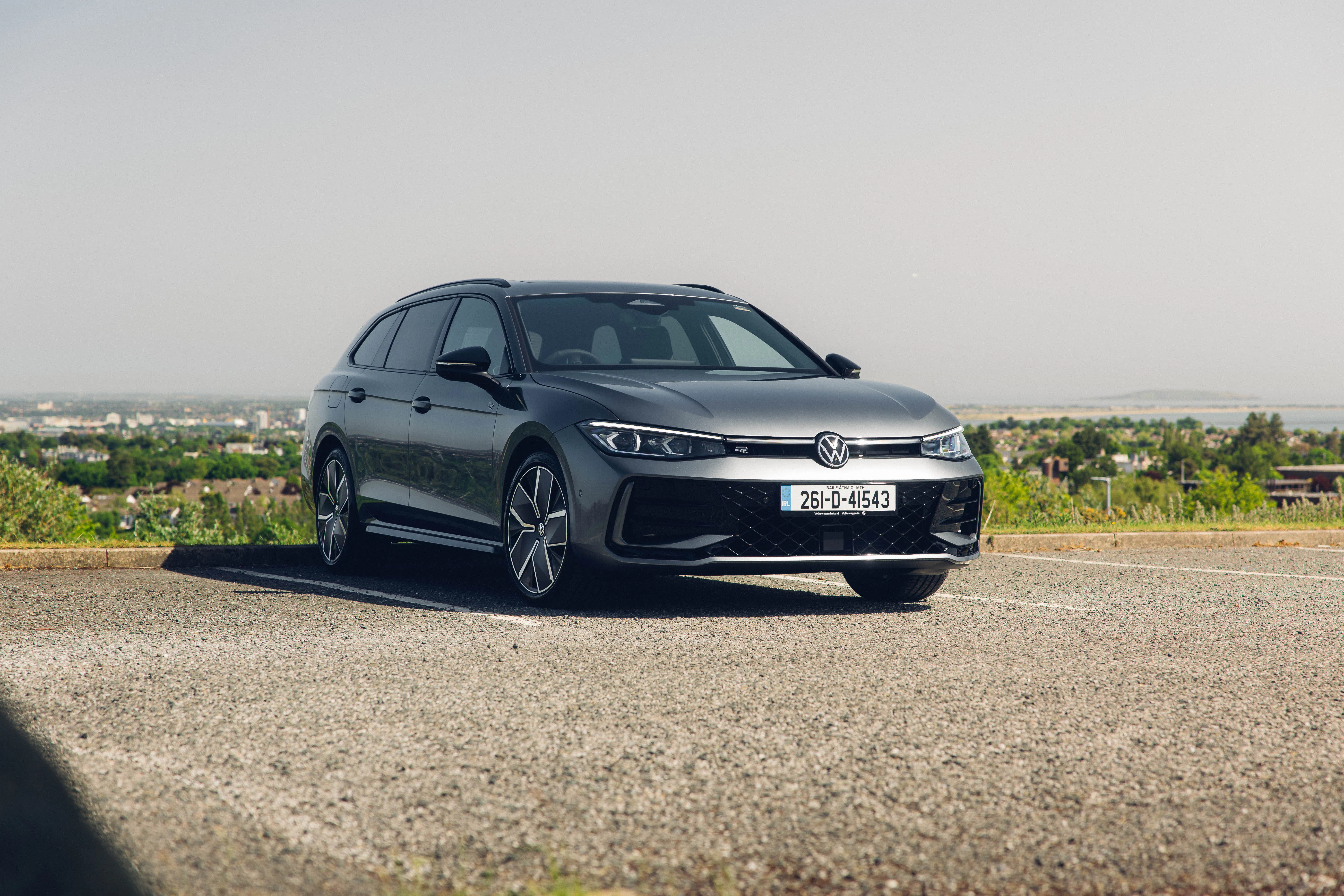
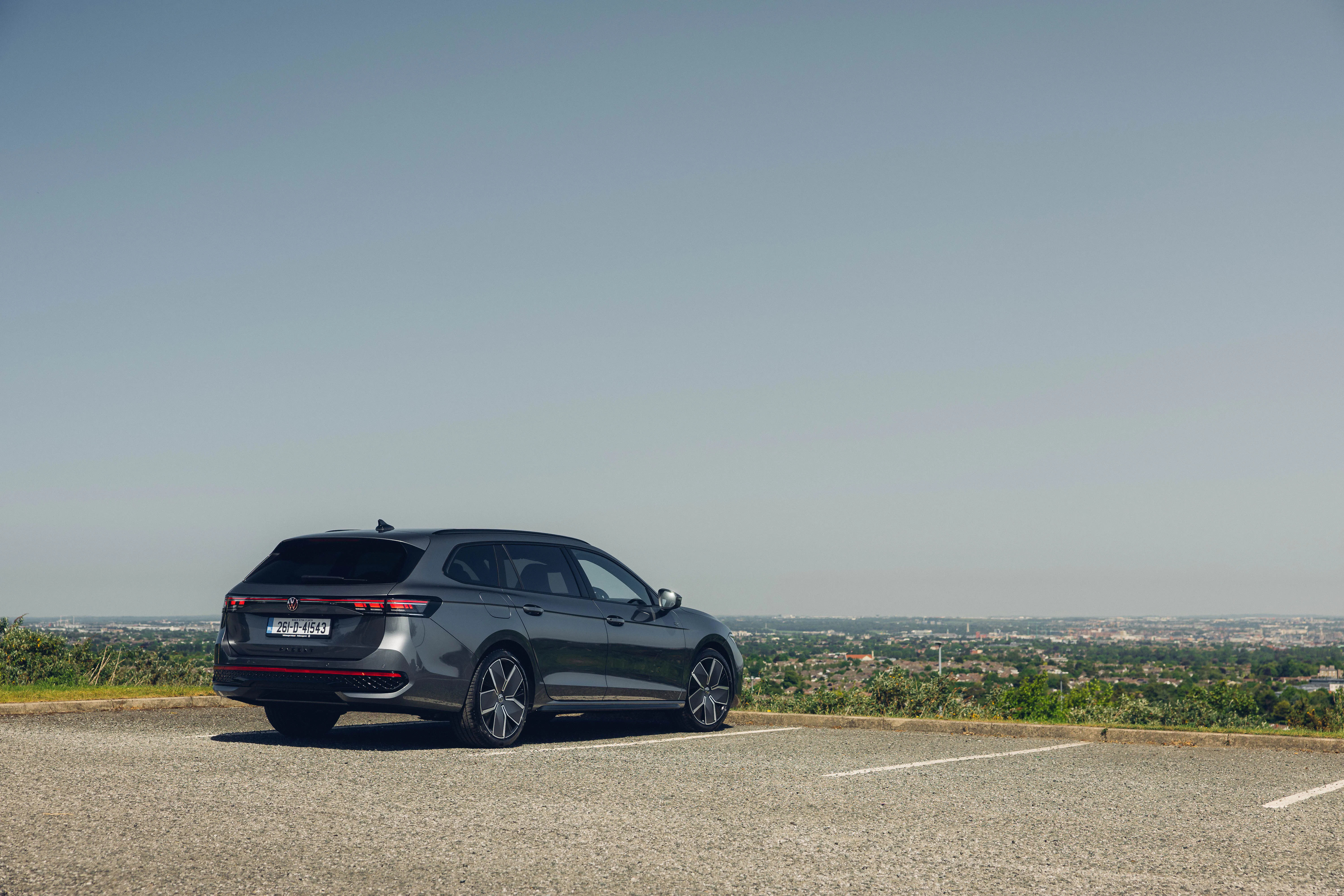
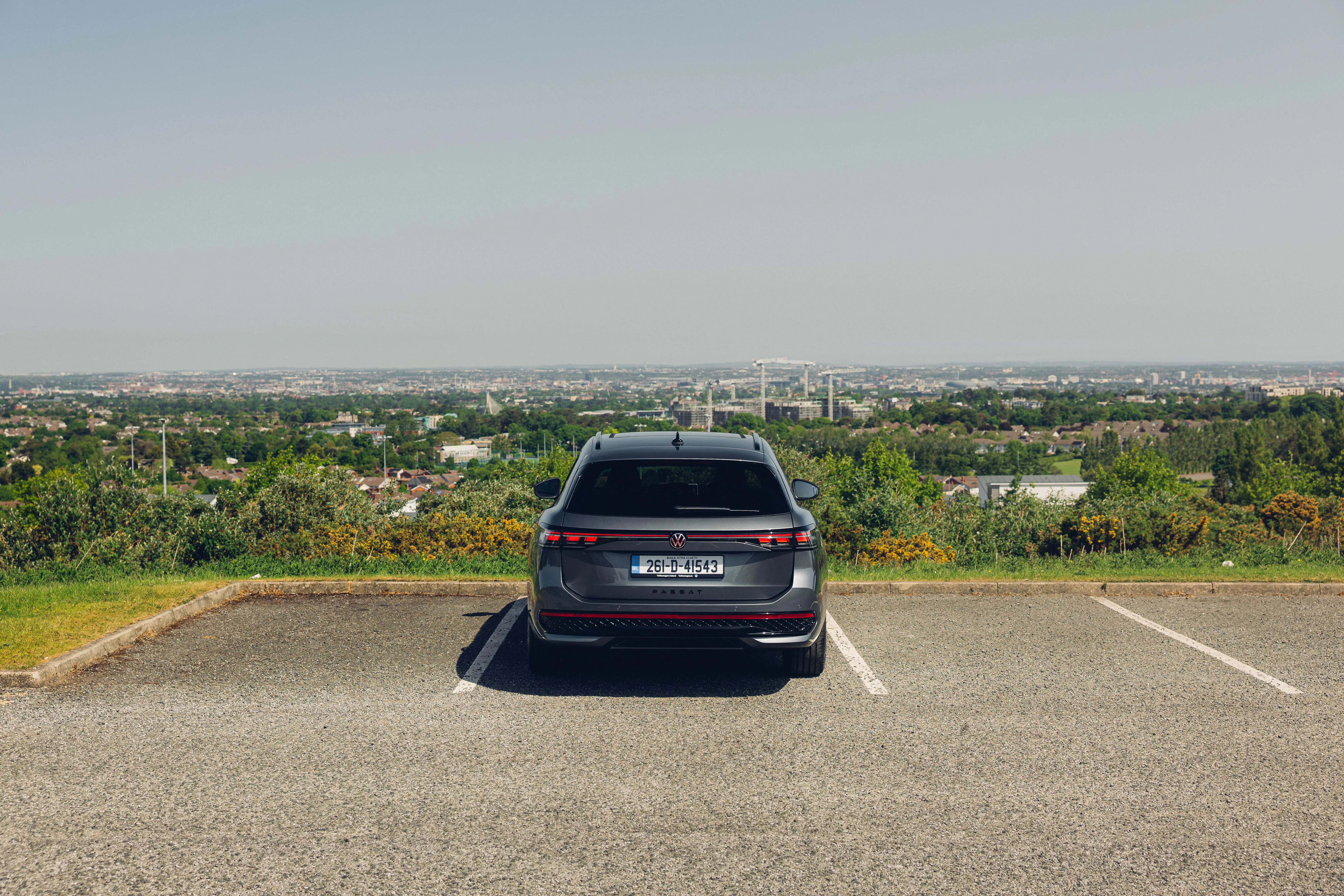
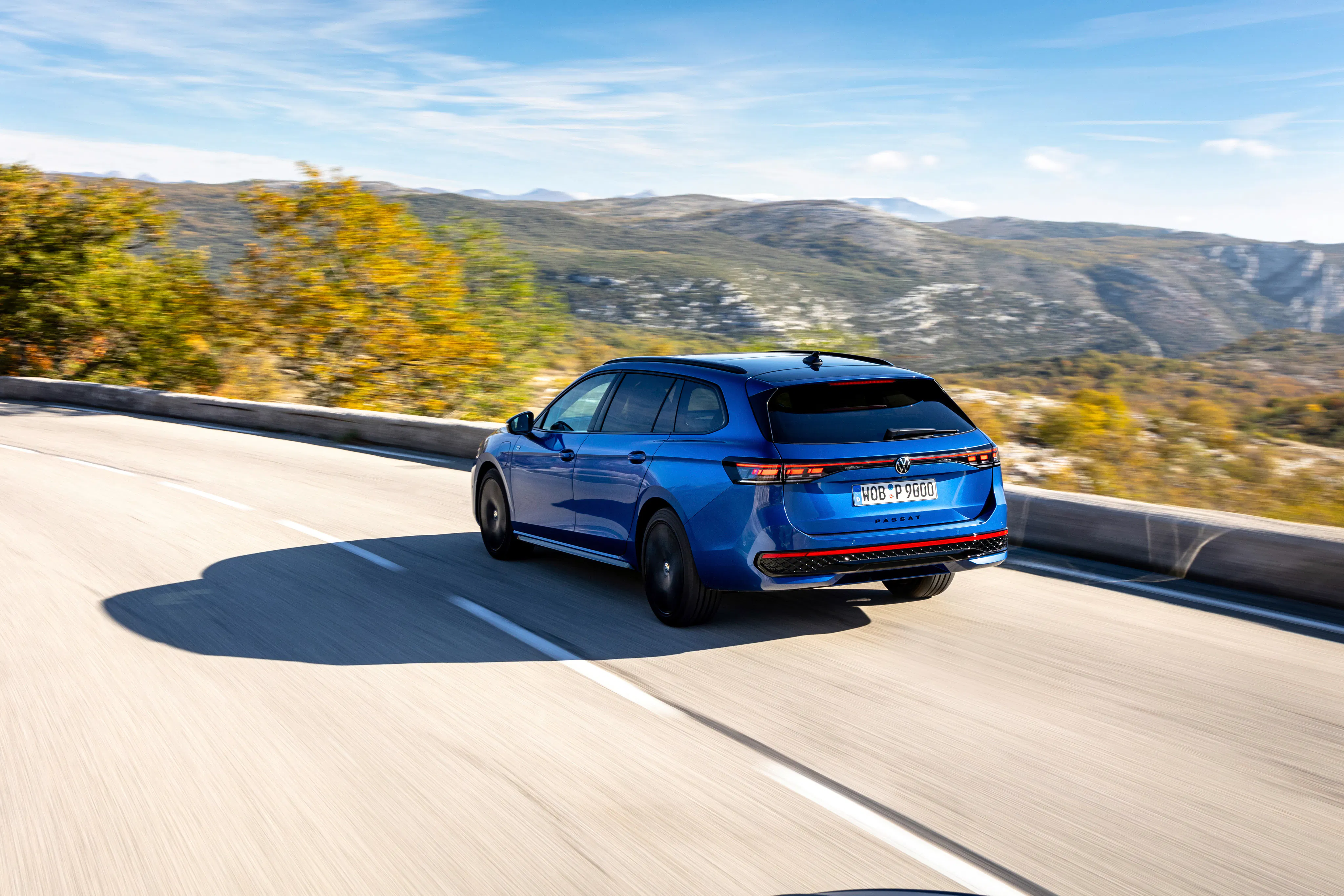
DoneDeal Cars Verdict: 4/5
Pros
- 690 litres of boot space (1,920 litres with the rear seats folded) beats most rivals in the segment
- Real-world fuel range is exceptional — easily over 1,000km from a single 66-litre tank on a mixed-driving fill
- R-Line spec brings 19" alloys, a panoramic sunroof, head-up display and R-Line sports seats as standard
Cons
- ROTR climbs quickly once you start adding options — our test car reached €60,186 with Adaptive Chassis Control and metallic paint
- Business-spec buyers miss out on the bigger 15" screen, heated seats and sunroof that come standard on R-Line
- Diesel VRT rate (19.25%) is nearly three times that of the eHybrid (7%), which will matter to some buyers on price alone
What is the Volkswagen Passat design like?
The current Passat is estate-only in Ireland — Volkswagen dropped the saloon body for this generation, and for Irish buyers that's no bad thing given how much load-carrying ability matters here. This ninth-generation car was developed from scratch, with a wheelbase 50mm longer than its predecessor's, freeing up an extra 50mm of rear legroom and adding 40 litres to the boot. VW's official Irish specification lists 4,916 mm length, 1,849 mm width and 1,521 mm height.
Aerodynamics were a clear engineering focus: the drag coefficient improved from 0.31 on the outgoing car to 0.25, helped by an electrically controlled radiator blind, air curtains around the front wheels to reduce turbulence and cool the brakes, a rear roof spoiler, D-pillar air guides and an underbody diffuser — all of which feed directly into the strong real-world fuel range covered below. The nose carries VW's current corporate face, with a full-width illuminated LED light bar linking the two-module LED headlamps, optionally upgraded to IQ.Light LED Matrix units with a notably longer main-beam range — standard across both Business and R-Line trims in Ireland. Round the back, continuous 3D LED tail light clusters with an illuminated VW logo and dynamic indicators give the car real road presence after dark, a design element used on this Passat generation for the first time.
R-Line spec, the trim tested here, adds a genuinely different look rather than just badges: a sportier diamond-pattern grille with aerodynamic side wings, black exterior mirror casings, high-gloss black window surrounds and roof rails, R-Line-specific front and rear bumpers with a red reflective strip, and the option of 19" Leeds alloys finished in black with dark graphite inserts. A panoramic sunroof is standard on R-Line (optional on Business), which does a lot to lift the otherwise dark-toned cabin. Nine exterior colours are available, though only Tornado Red is a no-cost solid colour — every metallic and pearlescent option, including our test car's Diabese Grey, carries an extra charge.
What is the Passat interior like?
This is where the Passat estate does its best work for Irish family and business buyers. Boot capacity is 690 litres with the seats up — genuinely class-leading territory — rising to 1,920 litres with the 60:40 rear bench folded flat. That's more than most mid-size SUVs and comfortably ahead of many direct rivals. Electric boot closing is standard on both trims.
The cabin is built around an entirely new cockpit architecture: a 10.25" Digital Cockpit Pro instrument display sits flush in the dash with an anti-glare coating, paired with R-Line's 15" Discover Pro touchscreen (Business gets 12.9") running VW's latest MIB4 infotainment software. Gear selection has moved to a steering-column stalk, freeing up genuine extra stowage space in the centre console. The IDA voice assistant is standard and — where enabled — can call on ChatGPT to answer general questions as well as control the car's own functions, a first for the Passat. A head-up display, standard on R-Line, is a genuinely useful addition on Irish motorways.
R-Line spec brings heated front and rear seats and a front massage function as standard, none of which Business-trim buyers get without ticking options. The seats themselves — VW's new ergoActive design — use pneumatic multi-chamber massage elements built into the backrest, a genuine step up from a simple heated-seat toggle. Volkswagen has also focused heavily on refinement here: acoustic glazing on the front and rear side windows, plus an acoustic windscreen as standard, are aimed at bringing wind and road noise down towards what you'd expect from a class above. Wireless smartphone charging, App Connect Wireless, and both a front and rear pair of USB-C ports are standard across the range, as is a 3-zone Climatronic system with an enhanced air filter. Three ISOFIX points (one front passenger, two rear) cover the practical family-buyer checklist.
Material quality is a step up from the outgoing Passat, with soft-touch surfaces on the dash and doors, though the sheer scale of the 15" touchscreen means several functions — climate control included — are buried in the infotainment system rather than left as physical switches, something that will divide opinion depending on how much you like touching a screen at 120km/h.
How does the Passat drive?
This is the perfect long distance cruiser and is very much set up to be.
Underneath, this generation gets a reworked chassis with MacPherson struts up front, a four-link rear axle with a new Vehicle Dynamics Manager that coordinates the electronic differential locks and, on cars fitted with the optional DCC Pro adaptive dampers, the lateral dynamics too. DCC Pro itself is a genuine technical step up: it moves from single-valve to two-valve dampers, allowing rebound and compression damping to be controlled separately for a wider spread between comfort and sharper responses than the old system offered, and it's a first for this class of MacPherson-strut suspension rather than the multi-link setups it was previously reserved for. R-Line models with DCC Pro also get quicker, more direct steering VW quotes 0.65 fewer turns lock-to-lock than the standard setup, down to 2.1 turns.
What are the Passat running costs in Ireland? (Running Costs & Efficiency)
For the 2.0 TDI 150HP R-Line tested here, annual motor tax is €210, based on WLTP CO2 emissions of 135 g/km and a VRT rate of 19.25%. The R-Line diesel starts at €55,995 before options, with a recommended On-The-Road price of €58,033 once the €2,038 delivery and service charge is included — our test car, finished in Diabese Grey metallic with the optional Adaptive Chassis Control (DCC) Pro package, came to €60,186 ROTR. There is no SEAI grant available on either the diesel or the eHybrid Passat, as that scheme applies only to fully electric vehicles.
Where the Passat genuinely impresses is real-world fuel range. On test, the trip computer showed roughly 1,200km of range from a full 66-litre tank at the start of the test period. After a Dublin-to-Cork round trip, that had dropped to 1,080km remaining, and a subsequent Dublin-to-Drogheda round trip still left around 400km in reserve before requiring a refill. That tracks closely with VW's own combined WLTP consumption figure of 5.0–5.4 l/100km, which on paper alone suggests a theoretical range approaching 1,300km — for high-mileage drivers who spend most of their time on motorways, this is one of the most efficient combustion-engined estates you can currently buy in Ireland. Service intervals and a 3-year/90,000km warranty apply across the range.
Passat Fuel Economy & Efficiency
Official combined consumption for the 2.0 TDI 150HP DSG is 5.0–5.4 l/100km, rising to 7.2–7.5 l/100km in WLTP's "low" (urban) test cycle and dropping to as little as 4.2 l/100km at "high" speeds — a reminder that this is an engine designed for motorway cruising rather than stop-start city driving. NOx emissions are quoted at 19.1 mg/km, within Euro 6 EB limits. In practice, and consistent with the tank range noted above, mixed Dublin-to-Cork and Dublin-to-Drogheda driving delivered fuel economy at or better than the official combined figure, which is unusual and worth flagging for anyone doing serious inter-city mileage.
Volkswagen also offers the Passat as a 1.5 eHybrid plug-in hybrid with 204HP, quoting a combined WLTP consumption of 1.3–1.6 l/100km and a CO2 figure of 29–36 g/km, thanks to a 19.7 kWh battery giving 120–134km of electric-only range. That battery takes around 2 hours 30 minutes to charge from a 11kW AC wallbox, or 12 hours from a domestic socket. Once the battery is depleted, real-world economy on the eHybrid typically settles in the 6–7 l/100km range on longer motorway runs — worth bearing in mind for buyers who won't be plugging in daily, as the diesel may actually work out cheaper to run on pure motorway mileage.
Rivals worth cross-shopping in Ireland
The closest rival is the Skoda Superb Combi, which shares much of its platform and powertrain with the Passat and starts from a broadly similar price point in Ireland, while offering even more outright boot space — worth a look for buyers prioritising ultimate practicality over badge.
Irish Prices for the Volkswagen Passat
Irish range and pricing (Passat, 2026):
- Business 2.0 TDI 150HP DSG — €50,995 (€53,033 ROTR); €210 annual motor tax
- R-Line 2.0 TDI 150HP DSG (tested) — €55,995 (€58,033 ROTR); €210 annual motor tax
- Business 1.5 eHybrid 204HP DSG — €47,995 (€50,033 ROTR); €140 annual motor tax
- R-Line 1.5 eHybrid 204HP DSG — €53,995 (€56,033 ROTR); €140 annual motor tax
ROTR includes Volkswagen's Delivery & Service charge of €2,038. Optional extras, metallic paint and packages (such as our test car's DCC Pro and Diabese Grey metallic paint, adding €2,153) are on top of these prices. No SEAI purchase grant applies to either the diesel or eHybrid Passat.
Buy with confidence
Trusted Dealer vehicles
This program highlights dealerships you can rely on. Dealers earn this certification by adhering to strict criteria.
Find Trusted Dealer carsGreenlight
Find Greenlight owner verified cars to purchase with confidence
Find Greenlight verified carsWarranty
Find Cars with warranties on DoneDeal, so that you can have peace of mind after purchase.
Find cars with warrantiesManufacturer approved
Find cars that have been quality checked and approved by their manufacturer.
Find approved cars